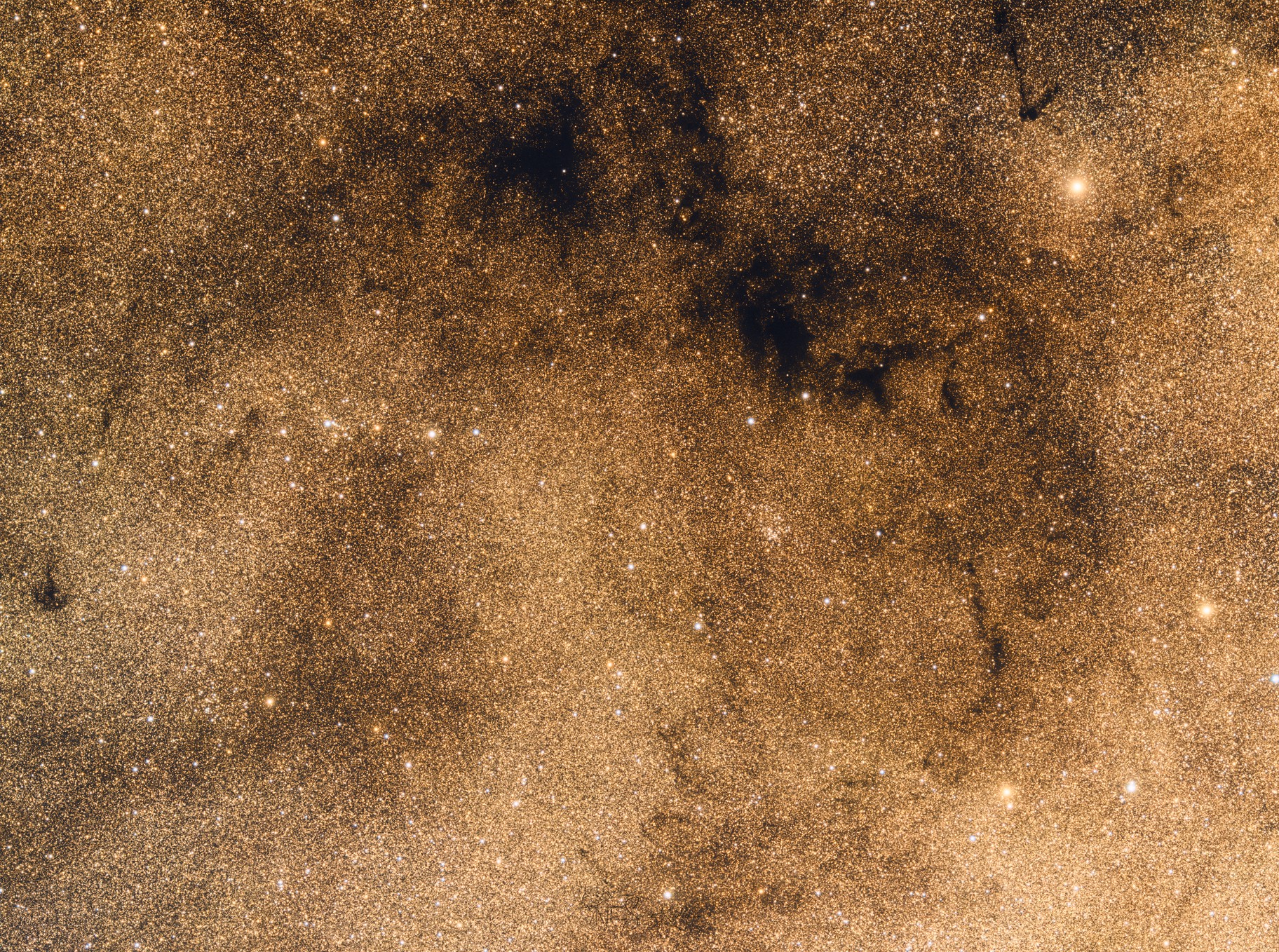
I’m calling this image Shielded. Partly because of the dark structures crossing the field, and partly as it is a region with Scutum, the constellation of “the Shield.”
This is one of the pictures I took while playing around with the Pegasus Astro NYX-88 mount over the past month. I keep coming back to the summer Milky Way because of regions like this: not just dense star fields, but places where the Galaxy seems to open up into these beautiful “galactic windows.”
A galactic window is a line of sight where the foreground dust is thin enough that we can look deeper into the Milky Way than usual. Much of the galactic plane is filled with interstellar dust, which absorbs and scatters visible light from the stars behind it. Where that dust becomes especially dense, it appears as dark nebulae: not empty space, but cold clouds of gas and dust silhouetted against the brighter stellar background. In a window, the curtain parts just enough to reveal layer after layer of distant stars.
This field sits in the rich summer Milky Way around Scutum, within the Scutum Star Cloud. The whole image is a dense golden sea of stars, but the shape and drama come from the dark nebulae cutting through it, including Lynds dark nebulae LDN 530 and LDN 547. These clouds are the “shield” in the image: foreground dust thick enough to hide the stars beyond, turning parts of the Milky Way into black, irregular silhouettes.
Also in the frame is Beta Scuti, the second-brightest star in Scutum, and the compact open cluster NGC 6705, better known as Messier 11 or the Wild Duck Cluster. M11 is one of the richer and more compact open clusters in the sky; in a wide-field image like this, it becomes a small, concentrated knot of starlight embedded in a much larger galactic context: a cluster inside a star cloud, seen through and around the dust of the Milky Way.
What I love about this region is that it feels like the boundary between a window and a wall. Move deeper into the darkest parts of the Milky Way’s midplane and the dust becomes so thick that it can completely erase the background stars from view. Here, the balance is just right: we can see deep into the Galaxy, but we can also see the material that prevents us from seeing even farther.
A shield, and an opening.
 The Space Koala Astrophotography by Luca Bartek